
Why Modern Businesses Need Smarter Notification Management
Customer communication has become one of the most critical components of modern business operations. Whether it is sending invoices, payment reminders, service alerts, account updates, subscription renewals, or transaction confirmations, organizations must ensure that the right information reaches the right stakeholders at the right time.
As businesses grow, managing communications manually becomes increasingly difficult. Multiple customer segments, complex billing structures, reseller networks, parent-child account hierarchies, and regulatory requirements create challenges that traditional communication methods cannot efficiently handle.
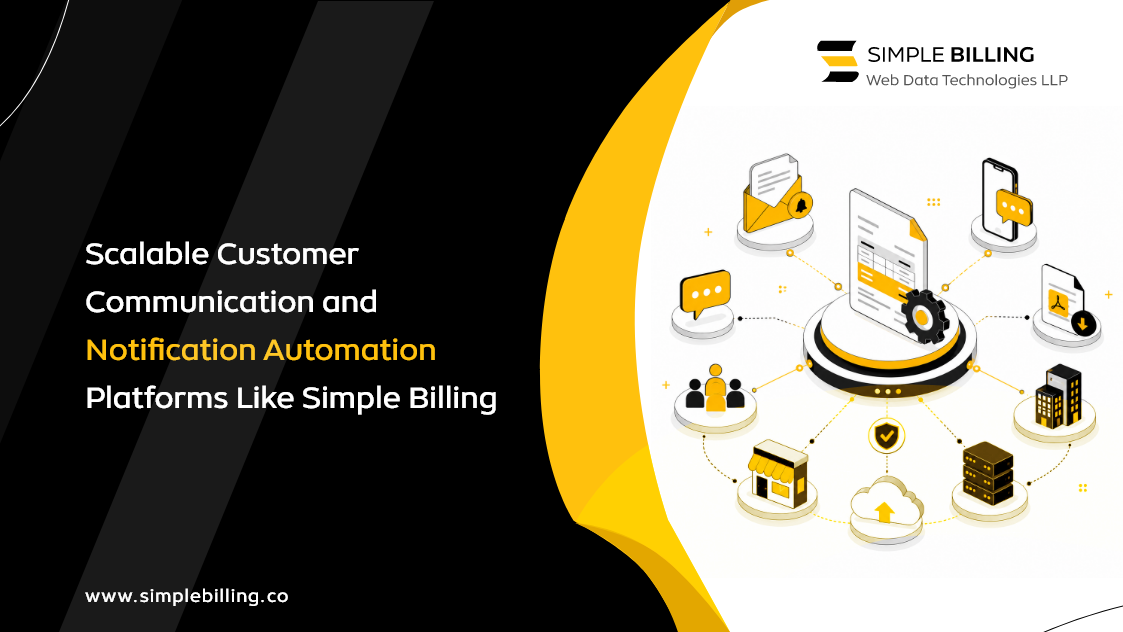
This is where scalable customer communication and notification automation platforms like Simple Billing provide significant value. By automating Email, SMS, and document-based notifications, organizations can streamline communication workflows, improve customer experiences, reduce operational overhead, and maintain complete visibility across all interactions.
The Growing Complexity of Customer Communications
Organizations today interact with a variety of stakeholders, each requiring different types of notifications.
These stakeholders may include:
- Administrators and Operations Teams
- Customers and Subscribers
- Parent Customers
- Child Accounts
- Resellers and Partners
- Finance Departments
- Support Teams
- Service Managers
Each stakeholder often requires unique communication preferences and notification triggers.
For example:
A customer may need an invoice notification and payment reminder.
A reseller may require account activity updates and commission reports.
A parent customer may need consolidated billing notifications for multiple child accounts.
An administrator may need operational alerts for failed payments or service provisioning events.
Without a centralized notification platform, managing these communication requirements becomes time-consuming and prone to errors.
The Role of Notification Automation
Notification automation eliminates the need for manual communication processes by automatically triggering messages based on business events.
Instead of employees manually sending emails or SMS messages, the system automatically delivers notifications when predefined events occur.
Examples include:
- Invoice generation
- Payment success confirmations
- Payment failure alerts
- Service activation notifications
- Subscription renewals
- Account balance updates
- Credit limit warnings
- Contract expiration reminders
- Usage threshold alerts
- Service suspension notices
Automated communication ensures consistency, accuracy, and timeliness while reducing administrative workload.
Multi-Channel Communication Through Email and SMS
Different customers prefer different communication channels.
Some customers rely heavily on email for official documentation, while others respond more quickly to SMS alerts.
A scalable notification platform should support both channels to maximize communication effectiveness.
Email Notifications
Email remains one of the most effective channels for detailed business communications.
Common email notifications include:
- Invoice delivery
- Payment receipts
- Monthly statements
- Subscription confirmations
- Service updates
- Account notifications
- Contract documents
- Billing summaries
Email allows organizations to include detailed information and attachments while maintaining a professional communication experience.
SMS Notifications
SMS provides immediate visibility and higher open rates for time-sensitive communications.
Organizations often use SMS for:
- Payment reminders
- Due date alerts
- Service notifications
- OTP verification
- Account status updates
- Renewal reminders
- Collection notifications
Combining Email and SMS creates a more reliable customer communication strategy.
Attachment-Based Notifications Improve Customer Experience
Modern billing communication extends beyond simple text messages.
Businesses frequently need to deliver supporting documents directly within notifications.
Examples include:
- PDF invoices
- Payment receipts
- Account statements
- Usage reports
- Tax documents
- Service agreements
- Credit notes
- Financial summaries
With attachment-enabled notifications, customers receive all relevant information in a single communication.
This reduces the need for follow-up requests, improves transparency, and accelerates payment cycles.
For customers, having immediate access to supporting documents enhances convenience and trust.
For businesses, it reduces support workload and improves operational efficiency.
Notification Automation for Customers
Customers expect timely and accurate communication.
Missed notifications can result in delayed payments, increased support requests, and customer dissatisfaction.
A notification automation platform helps customers stay informed through:
Invoice Notifications
Customers receive invoices immediately after generation.
Payment Confirmations
Customers receive confirmation once a payment has been successfully processed.
Renewal Reminders
Subscription and service renewals are communicated before expiration.
Usage Notifications
Customers can be notified when service usage approaches predefined limits.
Service Alerts
Any service changes, upgrades, or maintenance notifications can be communicated automatically.
These automated interactions help create a more transparent customer relationship.
Notification Automation for Parent Customers
Many organizations operate under parent-child account structures.
A parent customer may oversee multiple business units, departments, branches, or subsidiaries.
In such scenarios, communication requirements become more complex.
Parent customers often need:
- Consolidated billing summaries
- Multi-account payment notifications
- Child account activity updates
- Service usage reports
- Financial statements
A scalable notification platform ensures that parent customers receive appropriate visibility across all linked accounts while maintaining separate communication channels for child entities.
This creates better governance and financial oversight.
Notification Automation for Resellers and Partners
Resellers often manage large customer portfolios.
Keeping resellers informed about account activities is essential for maintaining strong customer relationships.
Automated notifications help resellers receive:
- New customer onboarding updates
- Payment confirmations
- Outstanding balance alerts
- Service activation notices
- Customer account status changes
- Revenue and commission reports
Rather than manually tracking account activities, resellers gain real-time visibility into their customer base.
This improves responsiveness and operational efficiency.
Internal Notifications for Administrators
Customer communications are only one side of the notification ecosystem.
Internal teams also require timely alerts to manage operations effectively.
Administrative notifications may include:
- Failed payment alerts
- Billing exceptions
- Credit threshold breaches
- Service provisioning failures
- Account suspension events
- Collection escalations
- System-generated warnings
These notifications help administrators proactively address issues before they impact customers.
By automating operational alerts, organizations can improve service quality and reduce response times.
Notification Archiving and Communication History
Sending notifications is only part of the process.
Organizations also need visibility into historical communications.
Notification archiving provides a centralized repository of all Email and SMS interactions.
This archive may include:
- Notification content
- Delivery timestamps
- Recipient information
- Associated account details
- Attached documents
- Delivery status
Having access to a complete communication history helps organizations:
- Resolve customer disputes
- Verify message delivery
- Support compliance requirements
- Improve audit readiness
- Analyze communication effectiveness
A searchable notification archive becomes an important operational and governance tool.
Benefits of a Centralized Notification Platform
A centralized notification management system offers numerous business advantages.
Improved Customer Experience
Customers receive timely and relevant communications.
Faster Payment Collection
Automated reminders help reduce overdue invoices.
Reduced Administrative Workload
Manual communication tasks are eliminated.
Increased Visibility
Organizations gain insight into every communication event.
Better Compliance
Notification records support regulatory and audit requirements.
Enhanced Scalability
Communication processes continue to operate efficiently as the business grows.
Greater Operational Efficiency
Teams spend less time managing communications and more time focusing on strategic initiatives.
How Simple Billing Supports Notification Automation
Simple Billing is designed to help organizations manage complex billing and communication requirements from a centralized platform.
Through integrated notification capabilities, businesses can automate Email and SMS communications for multiple stakeholder groups, including customers, administrators, parent customers, and resellers.
Organizations can streamline communication workflows by:
- Automating billing-related notifications
- Sending invoices and statements via Email
- Delivering time-sensitive SMS alerts
- Including supporting document attachments
- Managing stakeholder-specific communication preferences
- Maintaining centralized notification archives
- Tracking communication history with timestamps
- Supporting multi-account and reseller environments
This enables businesses to improve communication consistency while maintaining scalability.
Preparing for Future Growth
As businesses expand, communication volumes increase dramatically.
Manual processes that work for a few hundred customers often fail when organizations reach thousands or tens of thousands of accounts.
Scalable notification automation ensures that customer communications remain efficient regardless of business size.
By centralizing Email, SMS, attachment delivery, notification archiving, and stakeholder-specific communication workflows, organizations can create a communication framework that supports long-term growth.
Conclusion
Effective communication is essential to successful billing and customer management. Organizations that rely on manual processes often struggle to keep pace with growing customer expectations and operational complexity.
Scalable customer communication and notification automation platforms like Simple Billing help businesses deliver timely, accurate, and consistent notifications across Email, SMS, and document-based channels.
By automating communications for customers, administrators, parent customers, resellers, and partners, organizations can improve customer satisfaction, reduce operational overhead, accelerate collections, and maintain complete visibility into every interaction.
As digital business models continue to evolve, automated notification management will remain a critical component of efficient, customer-centric billing operations.