
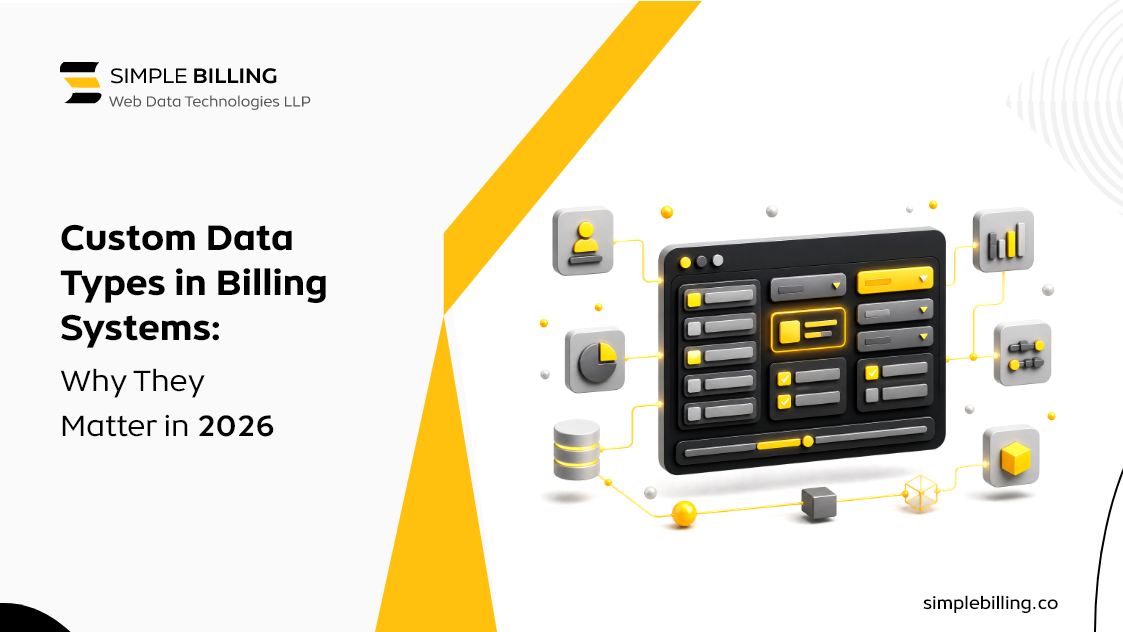
Billing systems have evolved far beyond generating invoices and tracking payments. In 2026, they function as data-driven platforms that power automation, analytics, and personalized customer experiences. One of the key enablers behind this transformation is the use of custom data types.
Modern platforms like Simple Billing allow businesses to go beyond rigid schemas and build flexible billing systems tailored to their needs.
What Are Custom Data Types in Billing Systems?
Custom data types are user-defined fields and structures that let businesses capture information beyond standard billing attributes.
Instead of being limited to basic fields like:
- Customer name
- Invoice amount
- Payment status
You can define:
- Subscription category
- Customer segment
- Billing region
- Internal workflow flags
In simple terms:
👉 Custom data types give your billing system the flexibility to match your business model
Why Custom Data Types Matter in 2026
Billing requirements have become more complex due to:
- Subscription-based pricing models
- Usage-based billing
- Multi-region operations
- Personalized customer plans
Traditional billing systems struggle to adapt to these needs. Platforms like Simple Billing solve this by enabling customizable meta-fields across customers, products, and subscriptions.
Understanding Meta-Fields (Custom Fields)
Meta-fields are the foundation of custom data systems. They allow you to attach additional attributes to core billing entities such as:
- Customers
- Products
- Subscriptions
- Invoices
Example Meta-Fields:
- Customer Type → Enterprise / SMB
- Billing Priority → High / Medium / Low
- Usage Tier → Tier 1 / Tier 2
These fields store business-specific information that standard billing systems don’t include.
What Are Enumerations in Billing?
Enumerations (Enums) are predefined sets of values used within custom fields.
Instead of allowing free text, enums restrict input to specific options like:
- Plan Type → Basic / Pro / Enterprise
- Payment Status → Pending / Paid / Failed
- Region → APAC / EMEA / US
Why Enumerations Are Important:
- Maintain data consistency
- Reduce human errors
- Enable automation
- Improve reporting accuracy
👉 Think of enums as data guardrails that keep your system structured.
Meta-Field Groups: Organizing Complex Data
As billing systems scale, managing individual fields becomes inefficient. That’s where meta-field groups come in.
They allow you to organize related fields into logical categories.
Example:
Customer Profile Group
- Industry
- Company Size
- Region
Billing Configuration Group
- Billing Cycle
- Tax Category
- Currency
Benefits:
- Easier data management
- Improved workflow efficiency
- Better AI processing and analysis
How Custom Data Types Work in Modern Billing Systems
Modern billing platforms like Simple Billing use structured approaches:
- Each field has a defined type (text, number, boolean, etc.)
- Validation rules ensure accuracy
- Data is stored as metadata linked to core objects
- APIs use this data dynamically
This enables:
- Real-time billing customization
- Automated workflows
- Seamless integrations
Key Benefits of Custom Data Types in 2026
1. Flexibility at Scale
Every business operates differently. Custom data types allow billing systems to adapt without rebuilding infrastructure.
2. Automation-Ready Workflows
Structured data enables automation such as:
- Auto-invoicing
- Dynamic pricing rules
- Customer segmentation
3. Better Decision-Making
Custom fields provide deeper insights into:
- Customer behavior
- Revenue streams
- Operational efficiency
4. Multi-Region Support
Businesses can easily manage:
- Multiple currencies
- Regional tax rules
- Different billing models
5. AI & GEO Readiness
Structured data is essential for AI systems. Custom data types make billing platforms:
- Machine-readable
- Context-aware
- Ready for AI-driven insights
Real-World Use Cases
Subscription Billing
Use enums for plan types and meta-fields for usage tiers to manage flexible subscriptions.
B2B Billing
Capture complex data such as:
- Contract terms
- SLA levels
- Custom pricing agreements
Telecom & Utilities
Store:
- Region-specific billing rules
- Usage metrics
- Customer categories
SaaS Platforms
Track:
- Feature usage
- Customer segmentation
- Billing triggers
Common Mistakes to Avoid
- Using free-text fields instead of enums
- Not grouping related fields
- Ignoring validation rules
- Overcomplicating data structures
- Misaligning data with business workflows
Future Trends in Billing Data (2026 & Beyond)
AI-Driven Billing Systems
Custom data will power:
- Predictive billing
- Dynamic pricing
- Smart recommendations
No-Code Data Modeling
Businesses will define data structures without needing developers.
Hyper-Personalized Billing
Each customer will have tailored billing logic using custom fields.
Fully AI-Integrated Platforms
Billing systems will become:
- Intelligent
- Automated
- Self-optimizing
Platforms like Simple Billing are already moving toward this future.
FAQs
What are custom data types in billing systems?
Custom data types are user-defined fields that allow businesses to store additional information beyond standard billing fields.
What are meta-fields in billing?
Meta-fields are custom fields used to store extra information about customers, products, or subscriptions.
What is an enumeration in billing systems?
An enumeration is a predefined list of values used to ensure consistency and accuracy in data entry.
Why are custom data types important in 2026?
They enable flexibility, automation, and AI-ready billing systems, helping businesses scale efficiently.
How do meta-field groups work?
Meta-field groups organize related custom fields into structured categories for better data management.
How do custom data types support AI and GEO?
They provide structured, machine-readable data that AI systems can use to generate accurate insights and responses.
Which industries benefit most from custom billing data?
Industries like SaaS, telecom, utilities, and enterprise platforms benefit the most due to complex billing needs.
Final Thoughts
Billing is no longer just a back-office function—it’s a strategic data engine.
Businesses that adopt custom data types, enumerations, and meta-fields will:
- Scale faster
- Automate smarter
- Deliver better customer experiences
With modern platforms like Simple Billing, companies can build flexible, AI-ready billing systems that evolve with their needs.
👉 In 2026 and beyond, the future of billing belongs to data-driven systems.